Why Credit Loss Assumptions Matter More Than Ever
Why Credit Loss Assumptions Matter More Than Ever
We have written extensively about our decision to avoid traditional direct lending (private loans to non-investment-grade companies) across our private debt platform. Direct lending and liquid high yield bonds have very similar credit risk factors. Both finance corporations whose ability to repay debt ultimately depend on cash flow from operations. As a result, many of the same drivers, including economic growth, earnings, and default cycles, determine long-term investment outcomes. By contrast, we’ve sought to diversify away from pure corporate credit risk by investing in strategies with different underlying risk factors, with the goal of creating a more resilient portfolio across market environments.
In our view, the case for direct lending has become even less compelling as the credit spread between private and public credit has narrowed. Today, direct lending is yielding roughly 240 basis points more than liquid high yield bonds, roughly half of the 480 basis point average observed between 2010 and 2021. Investors are still being compensated for illiquidity, but less than they were historically.
The returns of any debt investment are primarily the result of two factors: yield and loss rate (i.e.- a 10% starting yield and 1% loss rate results in a 9% net return). As the yield premium has been compressed, future performance is increasingly dependent on one assumption: that private credit will continue to experience meaningfully lower credit losses than comparable public debt.
Cliffwater’s (a leading data provider for the direct lending market) long-term capital market assumptions illustrate this dynamic well. They forecast unlevered, net-of-fee returns of 6.9% for direct lending versus 6.1% for high-yield bonds over the next decade. At first glance, this suggests a modest advantage for the private market. However, that advantage is driven almost entirely by one assumption: that annual credit losses average just 0.5% in direct lending compared to 1.5% in the public high-yield market.
As the table below illustrates, simply assuming equivalent loss rates causes the expected return advantage for direct lending to reverse.
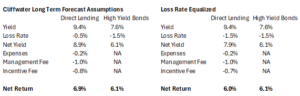
In other words, investors today are no longer being compensated solely for accepting illiquidity. They are implicitly betting that private corporate loans will continue to produce structurally lower defaults and/or higher recoveries than comparable public credits. That may ultimately prove correct, but we believe it is a much more important assumption than many investors appreciate.
Disclosures & Important Information
Any views expressed above represent the opinions of Mill Creek Capital Advisers ("MCCA") and are not intended as a forecast or guarantee of future results. This information is for educational purposes only. It is not intended to provide, and should not be relied upon for, particular investment advice. This publication has been prepared by MCCA. The publication is provided for information purposes only. The information contained in this publication has been obtained from sources that
MCCA believes to be reliable, but MCCA does not represent or warrant that it is accurate or complete. The views in this publication are those of MCCA and are subject to change, and MCCA has no obligation to update its opinions or the information in this publication. While MCCA has obtained information believed to be reliable, MCCA, nor any of their respective officers, partners, or employees accepts any liability whatsoever for any direct or consequential loss arising from any use of this publication or its contents.
© 2025 All rights reserved. Trademarks “Mill Creek,” “Mill Creek Capital” and “Mill Creek Capital Advisors” are the exclusive property of Mill Creek Capital Advisors, LLC, are registered in the U.S. Patent and Trademark Office, and may not be used without written permission.