Resilient, For Now
Resilient, For Now
The Iran conflict presents a predicament for investors. An extended conflict would certainly challenge global economic growth, but a quick resolution is likely to lead to a bounce-back in equity markets.
In the near term, we remain constructive about the economic outlook and the backdrop for risk assets:
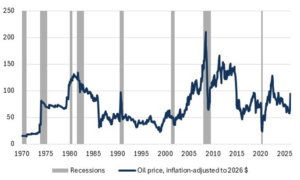
- Oil prices are not yet high enough to cause a global recession (Fig. 1),
- The global economy is less sensitive to oil price changes that it has been historically, and
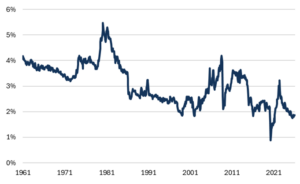
- US consumer spending on energy, as a percentage of personal income, is near all-time lows.
However, markets have been sanguine over the last two weeks with the S&P 500 only down about 2.5% since the end of February. For context, the 1973 Arab oil Embargo and the 1990 Gulf War led to US equity market (S&P 500) declines of -43.4% and -16%, respectively, but the 1979 Iranian Revolution and the 2022 start of the Russia-Ukraine did not lead to significant equity market sell-offs.
For now, we have not changed our allocation advice. To the extent possible, we believe a moderate investor (60/40 equities/bonds risk profile) should target 25% in high quality fixed income, 50% in global equities, 10% in asset-backed private credit, 5% in private equity, 5% in value-add real estate, 2.5% in hedge funds, and 2.5% in infrastructure.
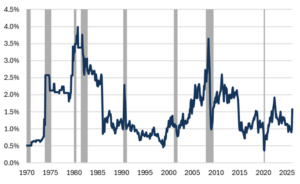
A longer (+ 2 months) closure of the Strait of Hormuz increases the risk of global economic stagflation and an equity bear market, particularly if oil price exceeds $125 a barrel for a sustained period. Spending on crude oil, as a percentage of global GDP, would reach 2% at $125 a barrel and 3% at $200 a barrel. We would likely reduce portfolio risk if such a scenario became more likely, but believe it is too early to do so at the current time.
Fig. 1: Historical oil prices and recessions
Source: Bloomberg, Mill Creek. As of 3/12/2026.
Fig 2: Crude oil spending as a percentage of global GDP
Source: Bloomberg, Mill Creek. As of 3/12/2026.
Fig. 3: US Consumer spending on gasoline and other energy good as a percentage of disposable personal income
Source: Bloomberg, Mill Creek. As of 3/12/2026.
Disclosures & Important Information
Any views expressed above represent the opinions of Mill Creek Capital Advisers ("MCCA") and are not intended as a forecast or guarantee of future results. This information is for educational purposes only. It is not intended to provide, and should not be relied upon for, particular investment advice. This publication has been prepared by MCCA. The publication is provided for information purposes only. The information contained in this publication has been obtained from sources that
MCCA believes to be reliable, but MCCA does not represent or warrant that it is accurate or complete. The views in this publication are those of MCCA and are subject to change, and MCCA has no obligation to update its opinions or the information in this publication. While MCCA has obtained information believed to be reliable, MCCA, nor any of their respective officers, partners, or employees accepts any liability whatsoever for any direct or consequential loss arising from any use of this publication or its contents.
© 2025 All rights reserved. Trademarks “Mill Creek,” “Mill Creek Capital” and “Mill Creek Capital Advisors” are the exclusive property of Mill Creek Capital Advisors, LLC, are registered in the U.S. Patent and Trademark Office, and may not be used without written permission.